Sunday, December 18, 2016

Ryōshin shiken

AS these beginners feel themselves to be very fervent and diligent in spiritual things and devout exercises, from this prosperity (although it is true that holy things of their own nature cause humility) there often comes to them, through their imperfections, a certain kind of secret pride, whence they come to have some degree of satisfaction with their works and with themselves. And hence there comes to them likewise a certain desire, which is somewhat vain, and at times very vain, to speak of spiritual things in the presence of others, and sometimes even to teach such things rather than to learn them. They condemn others in their heart when they see that they have not the kind of devotion which they themselves desire; and sometimes they even say this in words, herein resembling the Pharisee, who boasted of himself, praising God for his own good works and despising the publican.

St. John of the Cross. Dark Night of the Soul - Enhanced (Illustrated) (Kindle Locations 376-382). Kindle Edition.
Whenever I have a successful, or seemingly successful experience of teaching in church, the danger of this becomes clearly apparent.  How do we get past practicing a pretense of humility?

The Pharisee and the Publican
James Tissot [Public domain], via Wikimedia Commons

Monday, December 12, 2016

Samang Kirok

One should every day think over and make an effort to implant in his mind the saying, “At that time is right now.” It is said that it is strange indeed that anyone is able to pass through life by one means or another in negligence. Thus, the Way of the Samurai is, morning after morning, the practice of death, considering whether it will be here or be there, imagining the most sightly way of dying, and putting one’s mind firmly in death. Although this may be a most difficult thing, if one will do it, it can be done. There is nothing that one should suppose cannot be done.

The Matheson Trust; Yamamoto, Tsunetomo, Hagakure: In the Shade of the Leaves, Section 118 (p. 32) http://themathesontrust.org/library/hagakure-book-of-the-samurai
Different deaths have different emotional content.  Can the Samurai's resolute acceptance be consistent with giving up out of anger?

A Buddhist monk commits suicide by burning at the Central Market in Saigon, October 5, 1963

Sunday, December 11, 2016

Ryōshin shiken

"O Uniter of Attributes who came forth from the Cavern, I have not made extollings.
O Uniter of Good who came forth from the Cavern, I have not harmed the bread-ration of the Gods.
O Upraised of Head who came forth from the shrine, I have not stolen the Khenef-cakes from the Blessed
O He-who-Brings-his-Portion who came forth from the Hall of the Two Truths, I have not stolen Hefnu-cakes of a youth, nor have I fettered the god of my town.
O He-who-Brightens-the-Land who came forth from Faiyum, I have not slain sacred cattle."

Faulkner, Raymond. The Egyptian Book of the Dead: The Book of Going Forth by Day (Chronicle Books) (Plate 31 - Chapter 125) San Francisco.
 We steal from God when we serve objects of our own creation instead.  How am I like the priests hiding under the floor?

Destruction of the Statue of Bel
Cornelis Cort [Public domain], via Wikimedia Commons

Thursday, December 8, 2016

Samang Kirok

Dreams are truthful manifestations. When I occasionally have dreams of dying in battle or committing  seppuku, if I brace myself with courage, my frame of mind within the dream gradually changes. This concerns the dream I had on the night of the twenty-seventh day of the fifth month.

The Matheson Trust; Yamamoto, Tsunetomo, Hagakure: In the Shade of the Leaves, Section 113 (p. 31) http://themathesontrust.org/library/hagakure-book-of-the-samurai
I used to dream about being killed quite frequently; it was always the irrational rage of a close family member brought on when I confronted the person's delusion.  How would "bracing myself" in such dreams have changed my "frame of mind"?

Medea
Da Pompei, Casa dei Dioscuri https://commons.wikimedia.org/wiki/File:Medea_-_Casa_dei_Dioscuri.JPG

Ryōshin shiken

O Possessor of Two Horns who came forth from the Asyut, I have not be garrulous about matters.
O Nefertum who came forth from Memphis, I have not done wrong, I have not done evil.
O He-who-does-not-allow-Survivors who came forth from Busiris, I have not disputed the King.
O He-who-Acts-as-he-Wishes who came forth from Antinaiopolis, I have not waded in the water.
O Ihy who came forth from the Primordial Waters, my voice was not loud.
O He-who-Prospers-the-Common-People who came forth from Asyut, I have not cursed a god.

Faulkner, Raymond. The Egyptian Book of the Dead: The Book of Going Forth by Day (Chronicle Books) (Plate 31 - Chapter 125) San Francisco.
I was not properly silent; my word was ill-formed before I let it escape my lips and now the waters of another mind are muddied.  How does one sense the moment to speak?

Sayarim Valley South Masseboth
by Moti Shem Tov http://www.megalithic.co.uk/article.php?sid=14694

Monday, December 5, 2016

Samang Kirok

A certain person said, “In the Saint’s mausoleum there is a poem that goes:
Who in his heart
Follows the path of sincerity,
Though he does not pray
Will not the gods protect him?
What is this path of sincerity?”

 
A man answered him by saying, “You seem to like poetry. I will answer you with a poem:
As everything in this world is but illusion,
Death is the only sincerity.
Becoming as a dead man in one’s daily living
is following the path of sincerity.


The Matheson Trust; Yamamoto, Tsunetomo, Hagakure: In the Shade of the Leaves, Section 111 (p. 31) http://themathesontrust.org/library/hagakure-book-of-the-samurai 
For much of the activity in contemporary life, there is a need to function in respond to numerous unconnected, arbitrary, and often trivial demands.  What is there in my life that warrants sincerity unto death?

Sunday, December 4, 2016

Ryōshin shiken

O Youth who came forth from the Double Scepter Nome, I have not been neglectful of truthful words.
O Dark One who came forth from darkness, I have not cursed.
O He-who-Brings-his-Offering who comes forth from Asyut, I have not been violent.
O Proclaimer of Voice who came forth from Wenis, I have not confounded truth.
O Possessor of Faces who came forth from Dedjefet, I have not been impatient.
O Captain who came forth from Weten, I have not discussed.

Faulkner, Raymond. The Egyptian Book of the Dead: The Book of Going Forth by Day (Chronicle Books) (Plate 31 - Chapter 125) San Francisco.
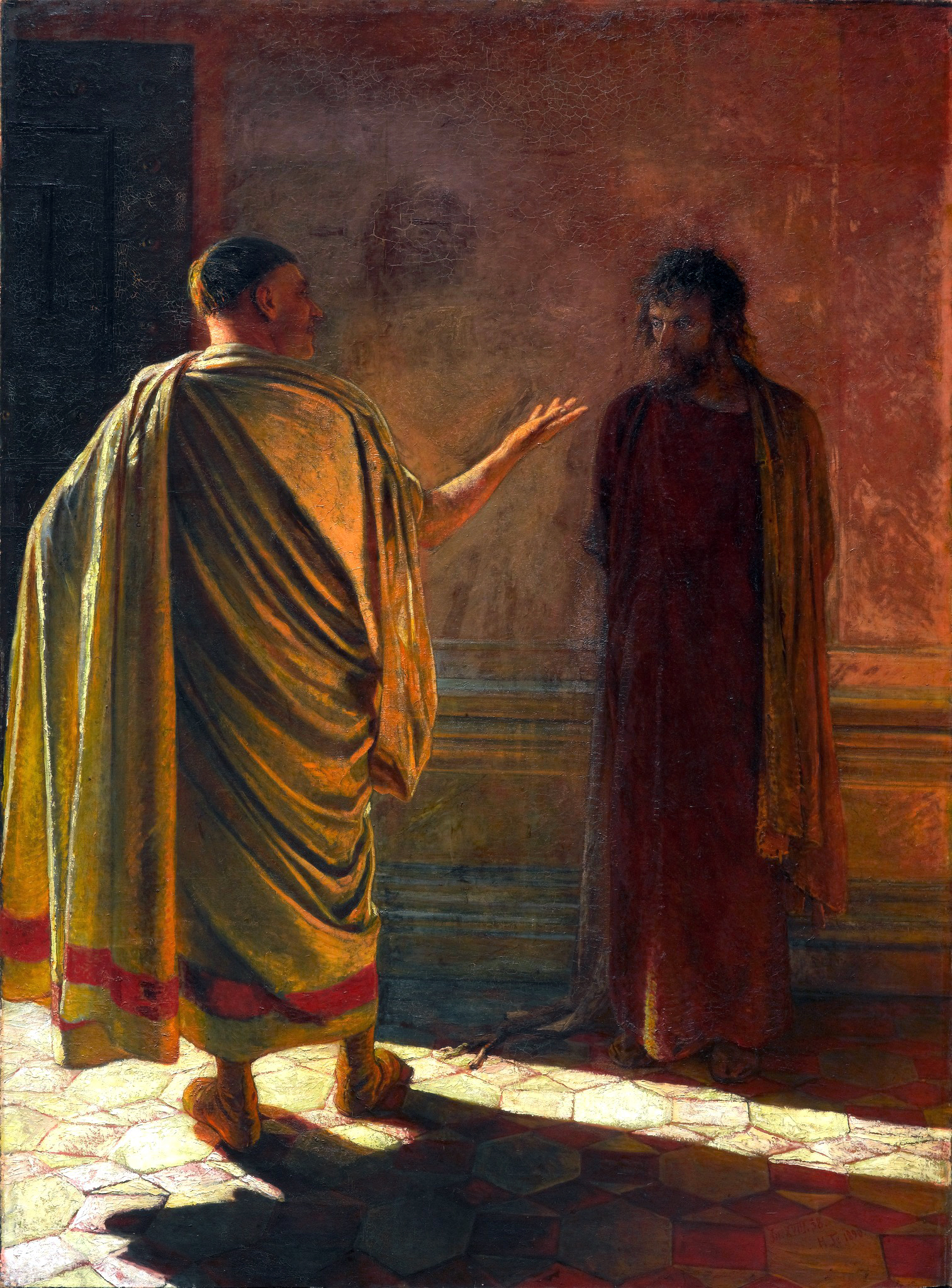
 I talked a lot today out of my own opinion.  How can I find the right balance between contributing my voice, and respecting the voice of the other(s)?

What is Truth?
Nikolai Ge [Public domain], via Wikimedia Commons

Samang Kirok

Whether people be of high or low birth, rich or poor, old or young, enlightened or confused, they are all alike in that they will one day die. It is not that we don’t know that we are going to die, but we grasp at straws. While knowing that we will die someday, we think that all the others will die before us and that we will be the last to go. Death seems a long way off. 

Is this not shallow thinking? It is worthless and is only a joke within a dream. It will not do to think in such a way and be negligent, insofar as death is always at one’s door, one should make sufficient effort and act quickly.

The Matheson Trust; Yamamoto, Tsunetomo, Hagakure: In the Shade of the Leaves, Section 109 (p. 30) http://themathesontrust.org/library/hagakure-book-of-the-samurai
It's a cliche, but it could happen today.  What am I leaving undone?

By ScottSteiner (Own work) [Public domain], via Wikimedia Commons
Or you could die like this spider: link

Saturday, December 3, 2016

Ryōshin shiken

"O Planter who came forth from Heliopolis, I have not disputed about property at all.
O Doubly Evil One who came forth from the Busirite Nome, I have not had intercourse with a married woman.
O He-who-Sees-what-he-has-brought who came forth from the House of Min, I have not wrongly copulated.
O He-who-is-over-the-Great-Ones who came forth from the house sealed with copper (House of Suasm)*, I have not struck terror.
O Demolisher who came forth from the grove of offering*, I have not transgressed.
O Proclaimer of Speech who came forth from Weyrt, I have not been hot-tempered."

Faulkner, Raymond. The Egyptian Book of the Dead: The Book of Going Forth by Day (Chronicle Books) (Plate 31 - Chapter 125) San Francisco. *Faulkner left these untranslated and I have added my own attempts referring to Sir Wallis Budge
Our passions motivate us to dramatic actions of every kind. My own failings in this matter seem to be driven by unexpressed anxiety.  How can I quickly identify that I'm operating out of that anxiety, and rein it towards more useful purposes?

The Chariot of the Body

Samang Kirok

"When the priest Daiyu from Sanshu was making a sick call at a certain place, he was told, “The man has just now died.” Daiyu said, “Such a thing shouldn’t have happened at this time. Didn’t this occur from insufficient treatment? What a shame!” 

Now the doctor happened to be there at that time and heard what was said from the other side of the shoji. He got extraordinarily angry and came out and said, “I heard Your Reverence say that the man died from insufficient treatment. Since I am a rather bungling doctor, this is probably true. I have heard that a priest embodies the power of the Buddhist Law. Let me see you bring this dead man back to life, for without such evidence Buddhism is worthless.” Daiyu was put out by this, but he felt that it would be unpardonable for a priest to put a blemish on Buddhism, so he said, “I will indeed show you how to bring his life back by prayer. Please wait a moment. I must go prepare myself,” and returned to the temple. Soon he came back and sat in meditation next to the corpse. Pretty soon the dead man began to breathe and then completely revived. It is said that he lived on for another half a year. As this was something told directly to the priest Tannen, there is nothing mistaken about it. 

When telling of the way he prayed, Daiyu said, 'This is something not practiced in our sect, so I didn’t know of any way of prayer. I simply set my heart for the sake of the Buddhist Law, returned to the temple, sharpened a short sword that had been given as an offering to the temple, and put it in my robe. Then I faced the dead man and prayed, ‘If the strength of the Buddhist Law exists, come back to life immediately.’ Since I was thus committed, if he hadn’t come back to life, I was resolved to the point of cutting open my stomach and dying embracing the corpse.'"

The Matheson Trust; Yamamoto, Tsunetomo, Hagakure: In the Shade of the Leaves, Section 101 (p. 28) http://themathesontrust.org/library/hagakure-book-of-the-samurai
 There is a great deal of energy in situations of absolute crisis, and it seems that it is necessary for every honest person to both believe and not believe in magic at the same time.  Are you really going to move to Canada, or are you just trying to create magic?


Friday, December 2, 2016

Ryōshin shiken

O Anointed One who came forth from the chapel, I have not dissembled.
O Hot-Legs who came forth at twilight, I have not transgressed.
O He-who-is-Blood who came forth from the place of slaughter, I have not done grain-profiteering.
O Eater of Entrails who came forth from the Council of Thirty, I have not robbed a parcel of land.
O Lord of Truth who came forth from Hall of Two Truths, I have not discussed secrets.
O Strayer who came forth from Bubastis, I have brought no lawsuits.

Faulkner, Raymond. The Egyptian Book of the Dead: The Book of Going Forth by Day (Chronicle Books) (Plate 31 - Chapter 125) San Francisco.
 When meeting our needs and desires depends on other people there's always pressure to provide an interface consistent with what the other wants or expects.  That said, how often do we hide our true value for fear, laziness, or simple unconsciousness?

Ski Mask XVII - Ski Mask Kid

Samang Kirok

For serious affairs that bear directly on oneself, if one does not take care of things by making his own judgment his foundation and breaking through headlong, matters will not be brought to a close. In conferring with people about matters of importance, there may be many cases when your affair is thought lightly of, or when people will not speak of the real circumstances. At such times one must use his own judgment. At any rate, it is sufficient to go crazy and choose to throw away one’s life. At such a time, if one thinks about doing things well, confusion will soon arise and he will blunder. In many cases one’s downfall may be brought about by an ally who is trying to do something for one’s benefit, or one may be killed by his friend’s kindness. It is the same as when one requests permission to become a monk. 

The Matheson Trust; Yamamoto, Tsunetomo, Hagakure: In the Shade of the Leaves, Section 94 (p. 26) http://themathesontrust.org/library/hagakure-book-of-the-samurai
There are many social threats to one's resolve, even from those who are concerned for you within their own understanding.  Do we want to mitigate the death brought on others by our own?
James Tissot [No restrictions or Public domain], via Wikimedia Commons

Thursday, December 1, 2016

Ryōshin shiken

"O He-whose-Eyes-are-in-Flames who came forth from Asyut, I have not stolen the god's property.
O Burning One who came forth backwards, I have not told lies.
O Breaker of Bones who came forth from Heracleopolis, I have not stolen food.
O Orderer of Flame who came forth from Memphis, I was not sullen.
O He-of-the-Cavern who came forth from the West, I have not fornicated with the fornicator.
O He-whose-face-is-behind-him who came forth from his hole, I have not caused anyone to weep."

Faulkner, Raymond. The Egyptian Book of the Dead: The Book of Going Forth by Day (Chronicle Books) (Plate 31 - Chapter 125) San Francisco.
Where do the spirits by which we judge ourselves come from? The light of fire and contrast reveal our true selves.
Namarato Spirits and the Rainbow Spirit Burlung
Australian Aboriginal art - replica in the Brno museum Anthropos

Samang Kirok

"Concerning martial valour, merit lies more in dying for one’s master than in striking down the enemy. This can be understood from the devotion of Sate Tsugunobu*."

The Matheson Trust; Yamamoto, Tsunetomo, Hagakure: In the Shade of the Leaves, Section 84 (p. 24) http://themathesontrust.org/library/hagakure-book-of-the-samurai
Bravery isn't winning, it's risking everything for your purpose, thus making your loss the true evidence.  How can we even imagine this, swamped in the trivialities of contemporary life?  Is Netflix worth dying for?
By Yōshū Chikanobu (Claremont Colleges Digital Library) [Public domain], via Wikimedia Commons
*Protecting his master, Tsugunobu is felled by Noritsune's arrow. Taira no Noritsune aiming his bow at Minamoto Yoshitsune, but hitting Satō Tsugunobu, who rode between to protect Yoshitsune. Noritsune's servant Kikuo is running forward to behead Tsugunobu

Wednesday, November 30, 2016

Ryōshin shiken

"O Wide-strider who came forth from Heliopolis, I have not done wrong.
O Fire embracer who came forth from Kheraha, I have not robbed.
O Nosey who came forth from Hermopolis, I have not stolen.
O Swallower of Shades who came forth from Kernet, I have not slain people.
O Terrible of Face who came forth from Rosetjau, I have not destroyed the food offerings.
O Double Lion who came forth from the sky, I have not reduced measures."

Faulkner, Raymond. The Egyptian Book of the Dead: The Book of Going Forth by Day (Chronicle Books) (Plate 31 - Chapter 125) San Francisco.
 There is an accountability at each potential point of error. Are these gatekeepers symbols for the individual's demons?

Samang Kirok

It is said that even after one’s head has been cut off, he can still perform some function. This fact can be known from the examples of Nitta Yoshisada and Ono Doken. How shall one man be inferior to another? Mitani Jokyu said, ”Even if a man be sick to death, he can bear up for two or three days.”

The Matheson Trust; Yamamoto, Tsunetomo, Hagakure: In the Shade of the Leaves, Section 62 (p. 19) http://themathesontrust.org/library/hagakure-book-of-the-samurai
To fight with such determination would leave one with no regret.  Do we ever wait for that moment, presuming that then we would fight bravely, while spending the rest of our lives in trivialities?
Head of Nitta Yoshisada

Tuesday, November 29, 2016

Ryōshin shiken


POINT 5 Exclamations of wonder, with intense feeling, as I reflect on the whole range of created beings, how ever have they let me live and kept me alive! The angels, who are the sword of divine justice, how have they endured me, and looked after me, and prayed for me! How have the saints been able to intercede and pray for me! And then the heavens, the sun, the moon, the stars and the elements, the fruits, the birds, the fishes and the animals, how have they kept me alive till now!As for the earth, how has it not opened to engulf me, creating new hells where I might suffer for ever! 

COLLOQUY I will conclude with a colloquy about mercy. All my thoughts will be about mercy and I will thank God for giving me life up till now, proposing to do better in the future with His grace. Our Father.

Munitiz, Joseph; Ignatius Of Loyola,. Personal Writings (Penguin Classics) (p. 297). Penguin UK. Kindle Edition.
So much of our technology, urbanization, and so forth separate us from the awareness of how precarious our existence is.  How can I keep a greater appreciation of this reality while working in an office?


Samang Kirok

The saying of Shida Kichinosuke, “When there is a choice of either living or dying, as long as there remains nothing behind to blemish one’s reputation, it is better to live,” is a paradox. He also said, “When there is a choice of either going or not going, it is better not to go.” A corollary to this would he, “When there is a choice of either eating or not eating, it is better not to eat. When there is a choice of either dying or not dying, it is better to die.”

When meeting calamities or difficult situations, it is not enough to simply say that one is not at all flustered. When meeting difficult situations, one should dash forward bravely and with joy. It is the crossing of a single barrier and is like the saying, “The more the water, the higher the boat.”


The Matheson Trust; Yamamoto, Tsunetomo, Hagakure: In the Shade of the Leaves, Section 57 (p. 18-19) http://themathesontrust.org/library/hagakure-book-of-the-samurai
There have been times in my life when my resolve caused me to embrace the more difficult challenges, and times when I've allowed laziness or complacency to win the day.  Can seeking resolute acceptance of permanent death, give us courage to risk the mini-death of failure?


Monday, November 28, 2016

Ryōshin shiken

"POINT 3 I look at who I am, diminishing myself by means of comparisons: (i) What am I compared to all human beings? (ii) What are all human beings compared to all the angels and saints in Paradise? (iii) What can I alone be, as I look at what the whole of creation amounts to in comparison with God? (iv) I look upon all the corruption and foulness of my body, (v) I look at myself as though I were an ulcer or an abscess, the source of many sins and evils, and of great infection. s

POINT 4 I consider who God is, against whom I have sinned, going through His attributes and contrasting them with their opposites in myself: His wisdom with my ignorance, His almighty power with my weakness, His justice with my injustice, His goodness with my malice."

Munitiz, Joseph; Ignatius Of Loyola,. Personal Writings (Penguin Classics) (p. 297). Penguin UK. Kindle Edition.
It seems that Ignatius is wise here in that although he suggests comparing the self with others, he refrains from suggesting an individual mortal should compare their self with another individual mortal.  It still runs the risk of allowing one to form an ego attachment to self-deprecation. 

My function in the world is tiny and insignificant.  Even so, I am responsible for that function.  How can a person compare their self with the mystery that is God?

Krishna Shows Arjuna His Universal Form
By Konddiah Raja, [Public domain], via Wikimedia Commons

Samang Kirok

Every morning, the samurai of fifty or sixty years ago would bathe, shave their foreheads, put lotion in their hair, cut their fingernails and toenails rubbing them with pumice and then with wood sorrel, and without fail pay attention to their personal appearance. It goes without saying that their armour in general was kept free from rust, that it was dusted, shined, and arranged. Although it seems that taking special care of one’s appearance is similar to showiness, it is nothing akin to elegance. Even if you are aware that you may be struck down today and are firmly resolved to an inevitable death, if you are slain with an unseemly appearance, you will show your lack of previous resolve, will be despised by your enemy, and will appear unclean. For this reason it is said that both old and young should take care of their appearance. 

Although you say that this is troublesome and time-consuming, a samurai’s work is in such things. It is neither busy-work nor time-consuming. In constantly hardening one’s resolution to die in battle, deliberately becoming as one already dead, and working at one’s job and dealing with military affairs, there should be no shame. But when the time comes, a person will be shamed if he is not conscious of these things even in his dreams, and rather passes his days in self-interest and self-indulgence. And if he thinks that this is not shameful, and feels that nothing else matters as long as he is comfortable, then his dissipate and discourteous actions will be repeatedly regrettable. 

The person without previous resolution to inevitable death makes certain that his death will be in bad form. But if one is resolved to death beforehand, in what way can he be despicable? One should be especially diligent in this concern.

The Matheson Trust; Yamamoto, Tsunetomo, Hagakure: In the Shade of the Leaves, Section 31 (p. 12) http://themathesontrust.org/library/hagakure-book-of-the-samurai 
A cursory look around my life shows little resolution to die.  What would be the daily activities that would prepare one to have their entire life exposed?  

By Wendelin Boeheim [Public domain], via Wikimedia Commons

Sunday, November 27, 2016

Ryōshin shiken

"PREAMBLE 2 This is to ask for what I want, and here it will be to ask for mounting and intense sorrow and tears for my sins.

POINT 1 This is the record of my sins, i.e. I recall to my memory all the sins of my life, looking from year to year or from one period of time to another, and for this three things are helpful: (i) to see the place and house where I lived, (ii) the relations I have had with others, (iii) the occupation in which I have spent my life.

POINT 2 I weigh up my sins, considering the intrinsic foulness and malice of each capital sin committed, quite apart from its being forbidden."

Munitiz, Joseph; Ignatius Of Loyola,. Personal Writings (Penguin Classics) (pp. 296-297). Penguin UK. Kindle Edition.
In some ways, what I once thought of as my greatest sins, external things, don't seem like much at all.  The real sinfulness I experience is too thoroughly integrated in my being to be readily tractable.  There are some who claim that it is best, once correction has been made, to essentially destroy all memory of past ill.  Isn't it better to have it around to provide the context for understanding?

Shea Discovers the Sword
The Brothers Hildebrandt

Samang Kirok


COLLOQUY Imagining Christ Our Lord before me on the cross, make a colloquy asking how it came about that the Creator made Himself man, and from eternal life came to temporal death, and thus to die for my sins. Then, turning to myself I shall ask, what have I done for Christ? what am I doing for Christ? what ought I to do for Christ? Finally, seeing Him in that state hanging on the cross, talk over whatever comes to mind.

A colloquy, properly so-called, means speaking as one friend speaks with another, or a servant with a master, at times asking for some favour, at other times accusing oneself of something badly done, or telling the other about one’s concerns and asking for advice about them. And then say an Our Father.

Munitiz, Joseph; Ignatius Of Loyola,. Personal Writings (Penguin Classics) (p. 296). Penguin UK. Kindle Edition.
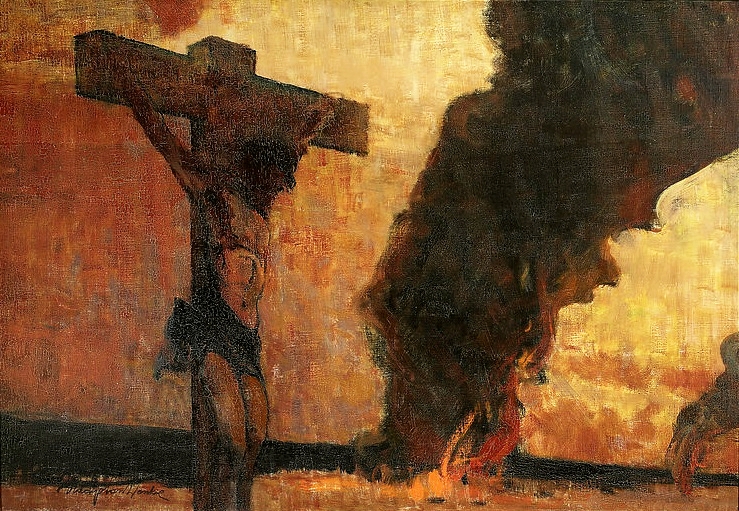
Christ's suffering and death on the cross is the ultimate sign that this is the God of the underdog, this is divine solidarity with miserable failure.  Why am I finding it so difficult to keep my concentration with this image?

Władysław Wankie [Public domain], via Wikimedia Commons

Saturday, November 26, 2016

Ryōshin shiken

COLLOQUY Imagining Christ Our Lord before me on the cross, make a colloquy asking how it came about that the Creator made Himself man, and from eternal life came to temporal death, and thus to die for my sins. Then, turning to myself I shall ask, what have I done for Christ? what am I doing for Christ? what ought I to do for Christ? Finally, seeing Him in that state hanging on the cross, talk over whatever comes to mind.

A colloquy, properly so-called, means speaking as one friend speaks with another, or a servant with a master, at times asking for some favour, at other times accusing oneself of something badly done, or telling the other about one’s concerns and asking for advice about them. And then say an Our Father.

Munitiz, Joseph; Ignatius Of Loyola,. Personal Writings (Penguin Classics) (p. 296). Penguin UK. Kindle Edition.
I've done something, but it seems so little considering the opportunity. How do I make sure that in my sermon tomorrow the focus comes to Christ's salvation and doesn't get caught up in my intellectualizing?  
Saint Luke as a Painter before Christ on the Cross
Francisco de Zurbarán [Public domain], via Wikimedia Commons

Samang Kirok

A certain person was brought to shame because he did not take revenge. The way of revenge lies in simply forcing one’s way into a place and being cut down. There is no shame in this. By thinking that you must complete the job you will run out of time. By considering things like how many men the enemy has, time piles up; in the end you will give up. No matter if the enemy has thousands of men, there is fulfillment in simply standing them off and being determined to cut them all down, starting from one end. You will finish the greater part of it.

Concerning the night assault of Lord Asano’s ronin, the fact that they did not commit seppuku at the Sengakuji was an error, for there was a long delay between the time their lord was struck down and the time when they struck down the enemy. If Lord Kira had died of illness within that period, it would have been extremely regrettable. Because the men of the Kamigata area have a very clever sort of wisdom, they do well at praiseworthy acts but cannot do things indiscriminately, as was done in the Nagasaki fight.


Although all things are not to be judged in this manner, I mention it in the investigation of the Way of the Samurai. When the time comes, there is no moment for reasoning. And if you have not done your inquiring beforehand, there is most often shame. Reading books and listening to people’s talk are for the purpose of prior resolution.


Above all, the Way of the Samurai should be in being aware that you do not know what is going to happen next, and in querying every item day and night. Victory and defeat are matters of the temporary force of circumstances. The way of avoiding shame is different. It is simply in death. Even if it seems certain that you will lose, retaliate. Neither wisdom nor technique has a place in this. A real man does not think of victory or defeat. He plunges recklessly towards an irrational death. By doing this, you will awaken from your dreams.

The Matheson Trust; Yamamoto, Tsunetomo, Hagakure: In the Shade of the Leaves, Section 25 (p. 10) http://themathesontrust.org/library/hagakure-book-of-the-samurai
Although the specific time-scale is different, plunging recklessly and indiscriminately is required of warriors of the pen as well as the sword.  How can one really be prepared to throw life away in an instant?

Igagoe buyuden - Saga of Iga Pass
Konishi Hirosada [Public domain], via Wikimedia Commons

Friday, November 25, 2016

Ryōshin shiken

"WAY OF MAKING THE GENERAL EXAMEN containing five points 
POINT 1: to give thanks to God for the benefits received. 
POINT 2: to ask for grace to know one’s sins and reject them. 
POINT 3: to ask an account of one’s soul from the hour of rising to the present examen, hour by hour, or from one period to another, first about thoughts, then about words and finally about deeds, following the order given in the particular examen.
POINT 4: to ask God Our Lord for pardon for sins. 
POINT 5: to determine to do better with His grace, ending with an Our Father."

Munitiz, Joseph; Ignatius Of Loyola,. Personal Writings (Penguin Classics) (p. 293). Penguin UK. Kindle Edition.
Start with thanks.  Why is my arm in so much pain?


Samang Kirok

"If one looks at the world when affairs are going smoothly, there are many who go about putting in their appearance, being useful by their wisdom, discrimination and artfulness. However, if the lord should retire or go into seclusion, there are many who will quickly turn their backs on him and ingratiate themselves to the man of the day. Such a thing is unpleasant even to think about. Men of high position, low position, deep wisdom and artfulness all feel that they are the ones who are working righteously, but when it comes to the point of throwing away one’s life for his lord, all get weak in the knees. This is rather disgraceful. The fact that a useless person often becomes a matchless warrior at such times is because he has already given up
his life and has become one with his lord. At the time of Mitsushige’s death there was an example of this. His one resolved attendant was I alone. The others followed in my wake. Always the pretentious, self-asserting notables turn their backs on the man just as his eyes are closing in death. Loyalty is said to be important in the pledge between lord and retainer. Though it may seem unobtainable, it is right before your eyes. If you once set yourself to it, you will become a superb retainer at that very moment."


The Matheson Trust; Yamamoto, Tsunetomo, Hagakure: In the Shade of the Leaves, Section 9 (p. 5) http://themathesontrust.org/library/hagakure-book-of-the-samurai
 My desire to throw it all away is imperfect.  How does death signify unity between persons?

Plate IV Frederic Loisel - Lithograph
http://sacredartpilgrim.com/collection/view/28

Thursday, November 24, 2016

Ryōshin shiken

"ADDITION 2 Since the first line of the diagram represents the first examen, and the second line the second examen, the exercitant can see at night if there is an improvement from the first line to the second, i.e. from the first examen to the second. 

ADDITION 3 The second day should be compared with the first, i.e. today’s two examens with yesterday’s two examens, to see if there is an improvement from one day to another. 

ADDITION 4 One week should be compared with another to see if there is an improvement between the present week and the preceding. 

NOTE The first two long lines in the following diagram stand for Sunday, the second shorter ones for Monday, the third for Tuesday, and so on."

Munitiz, Joseph; Ignatius Of Loyola,. Personal Writings (Penguin Classics) (pp. 290-291). Penguin UK. Kindle Edition.
 How do we know if we improve without measuring?  I'm not yet measuring the right things.

Samang Kirok

"Sagara Kyuma was completely at one with his master and served him as though his own body were already dead. He was one man in a thousand.

Once there was an important meeting at Master Sakyo’s Mizugae Villa, and it was commanded that Kyuma was to commit seppuku. At that time in Osaki there was a teahouse on the third floor of the suburban residence of Master Taku Nui. Kyuma rented this, and gathering together all the good-for-nothings in Saga he put on a puppet show, operating one of the puppets himself, carousing and drinking all day and night. Thus, overlooking Master Sakyo’s villa, he carried on and caused a great disturbance. In instigating this disaster he gallantly thought only of his master and was resolved to committing suicide."


The Matheson Trust; Yamamoto, Tsunetomo, Hagakure: In the Shade of the Leaves, Section 7 (p. 4) http://themathesontrust.org/library/hagakure-book-of-the-samurai
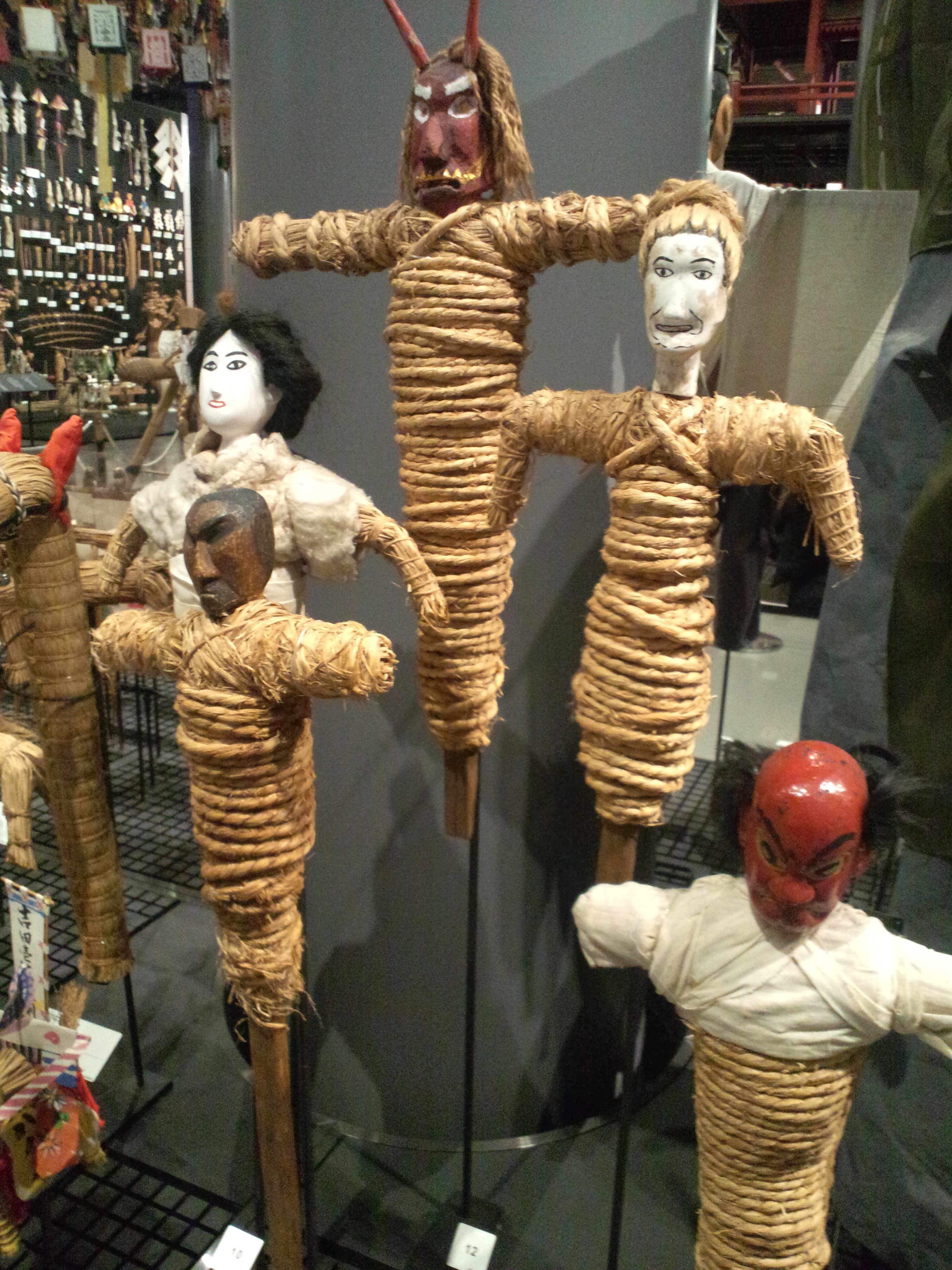
Kyuma was one with Sakyo at the end, but not at the beginning.  What puppet shows am I operating?

By Yanajin33 (Own work) [CC BY-SA 3.0 (http://creativecommons.org/licenses/by-sa/3.0)], via Wikimedia Commons

Wednesday, November 23, 2016

Ryōshin shiken

"the SECOND EXAMEN will be made in the same way, going from hour to hour from the first examen to this second one. On the second line of the same diagram as many marks should be made as the times one has fallen into the particular sin or defect."

Munitiz, Joseph; Ignatius Of Loyola,. Personal Writings (Penguin Classics) (p. 290). Penguin UK. Kindle Edition.
Do we decide implicitly the particular sins that ensnare us? (Hebrews 12:1)  Facebook is a major waste of time.

The Examen Prayer Card

Samang Kirok

"I have come to understand that the Way of the Samurai is that of dying. When a warrior comes to a life-or-death situation, there is for him only the quick choice of death. There are no other details; be determined and advance.

To say that dying without reaching one’s aim is to die in vain is a frivolity of wimpish samurai. When pressed with the choice of life or death, it is no longer necessary to gain one’s aim. We all want to live, and in large part we reason our way into clinging to life. Now, not pursuing our aim and continuing to live: that is cowardice. This is a thin dangerous line. But if you sacrifice everything to obtain your goal and die short of fulfilling it, you have nothing to be ashamed of.

This is the essence of the Way of the Samurai: you must die anew every morning and every night. If you continually preserve the state of death in everyday life, you will understand the essence of Bushido, and you will gain freedom in the Way. Your whole life will be without blame, and you will succeed in your calling."

The Matheson Trust; Yamamoto, Tsunetomo, Hagakure: In the Shade of the Leaves, Section 2 (p. 3) http://themathesontrust.org/library/hagakure-book-of-the-samurai
 How do I make death a quick choice?  If I want to live without shame, I've got a lot of work to do.

© CEphoto, Uwe Aranas / , via Wikimedia Commons

Tuesday, November 22, 2016

Ryōshin shiken

"FIRST EXAMEN: it consists of demanding of oneself an account of the particular point proposed for correction and reform, running over each hour or each period of time, beginning from the hour of rising, up to the hour and moment of the present examen. On the first line of the diagram as many marks should be made as times one has fallen into the particular sin or defect. Then one should resolve again to do better up to the next examen to be made."
Munitiz, Joseph; Ignatius Of Loyola,. Personal Writings (Penguin Classics) (p. 290). Penguin UK. Kindle Edition. 

This depends on the particular sin or defect chosen.  Does starting something new in response to a long discernment process count as labor against a sin or defect?

Peter Paul Rubens [Public domain], via Wikimedia Commons